TURNER ON THE CONTINENT - in the Bernese Oberland

from William Turner's 'Château de Rinkenberg, on the Lac de Brienz, Switzerland' 1809 watercolour courtesy The Taft Museum of Art public domain image cropped
Turner in the Bernese Oberland
Written without assistance from AI
We were delighted that the Taft Museum of Art and the Cincinnati Art Museum jointly celebrated Turner's 250th birthday with a very special Watercolour Horizons Exhibition that was on until June 15, 2025. It had been 40 years since these two leading museums came together like this, so, we hope that many of you were able to take advantage of this once-in-a-lifetime opportunity to see these important watercolours in one place.
With our specialist knowledge of Turner in Switzerland, we at turner250.com had planned to add what we hoped would be interesting background to two of the exhibited paintings : the one that Turner himself called "Rinkenberg" (that today is spelled "Ringgenberg") and the other called "Lake of Thun". In the event, we had far to much work to do elsewhere, so this task was only completed for the Ringgenberg one. And our problem with the Lake Thun one was that we were unable to locate it there, nor suggest its true location. This therefore remains an outstanding task. Nevertheless, please enjoy this page.

JMW Turner - "Château de Rinkenberg, on the Lac de Brienz, Switzerland" - 1809 - Courtesy The Taft Museum of Art ref: 1931.388
Turner had a wonderful visual memory, backed up by his ceaseless sketching in small notebooks that he would have used to help recall certain details. In this case there is a very cursory and hurried pencil sketch made from the water in 1802 that simply recalls the arrangement of the house, the church and the castle. This may be consulted at tate.org.uk by searching for D04761.
Whilst on the 1802 tour he made a more detailed study that you will immediately recognise as the model for the above work:
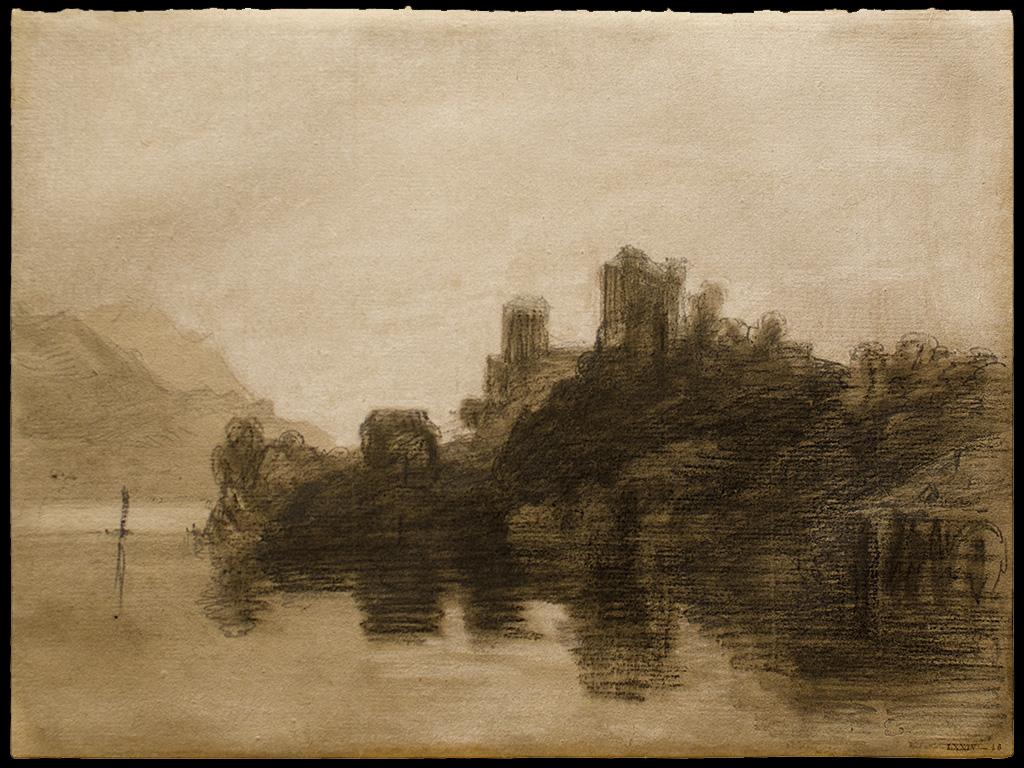
JMW Turner 1802 - Grenoble Sketchbook LXXIV-46 Tate ref: D04539 Ringgenberg Castle, Lake of Brienz 213 x 284 mm Image by John Lumby at Tate Britain ref 20111116-A-8434 public domain
The view is from the lake, from where he may have made the initial pencil sketch. As with other pencil sketches in the Grenoble Sketchbook, he then completed the view with so-called 'black chalk' that was most likely a 'Conté Crayon' purchased in Paris and the latest thing for artists to explore. The sketches in the sketchbook show increasing experimentation as the tour progresses, and in this case, the Conté Crayon conveys this evening scene in a way that would otherwise not have been possible with a pencil.
We are looking due West into a low evening sun obscured by misty clouds. The very dark areas are those that even the very bright refracted light from the clouds fails to illuminate.
Turner is a master of communication, as long as the observer is willing to give time to absorbing and studying the scene. We are struck by the tranquility, by the silence, as we sail around this last part of the lake towards our overnight accommodation.
The pages of this sketchbook were separated and titled, probably by Turner himself to show patrons and clients. However, the titles became separated and the order of the pages lost.
It seem likely that his colleague and patrion Walter Fawkes saw this sketch and commissioned Turner to make the finished watercolour that is now with the Taft.
In viewing the finished work, Turner has added precise shadow lines from the sun. So, by following those lines upwards, their point of intersection informs us of the position of the sun.
These two versions pose a question that arises throughout Turner's work. Our opinion is that he made the pencil and crayon sketch primarily, and maybe initially solely for himself, whereas the Taft watercolour meets the typical requirements of a paying client. Like the client, we are readily pleased and satisfied with this beautiful watercolour's tranquil landscape with people relaxing and enjoying a pleasant, quiet evening on the lake, whereas, the dark study requires rather more observation and consideration.
Here is a more distant view of the ruined Ringgenberg Castle:
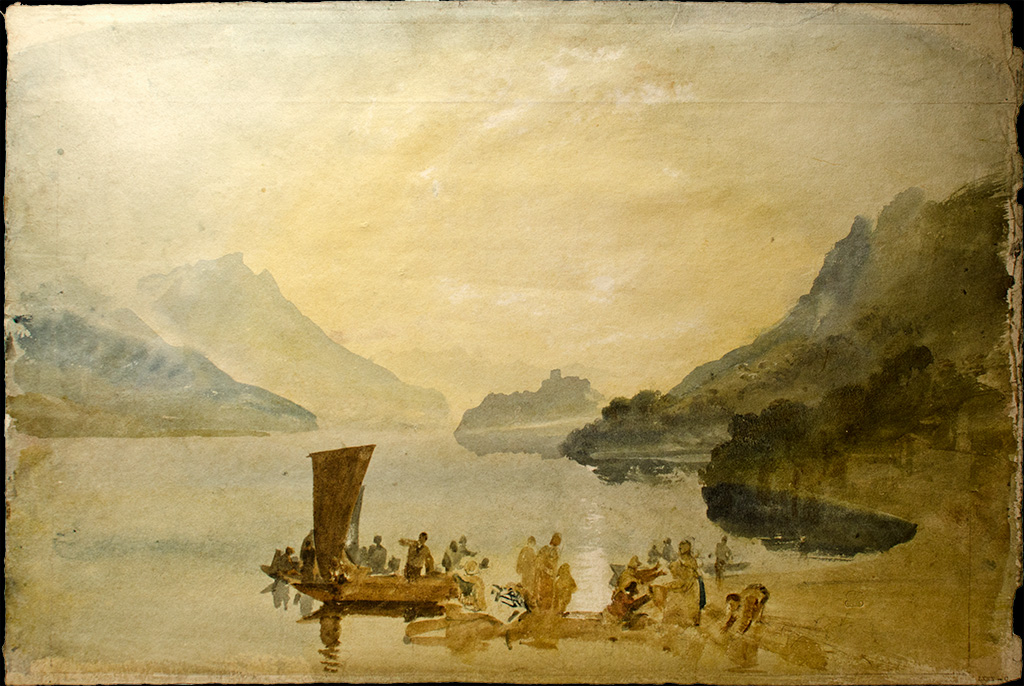
JMW Turner 1809 c - Lake Brienz and Ringgenberg Castle - pencil and watercolour 440 x 296 mm Turner Bequest B-LXXX C_Tate ref D04896_Image John Lumby at Tate Britain_ref: 20111116-8698
The palette is very similar to the Taft watercolour, although there's been quite a bit of fading of the colours. The time of day seems to be a little earlier, so this view preceeds the Taft one. The sequence of Turner's views and pencil sketches often allow us to appreciate his day's experiences. The boat here is about to leave, so it's reasonable to suppose that it is the one just rounding the headland in the Taft watercolour.
We'll now take a look at the castle and church today :

Ringgenberg Castle and Church on Lake Thun © John Lumby 20160210-5162
We are now able to appreciate that the 17th Century church was built inside the Castle that had been ruined in the 14th century. It is a Swiss Protected Federal Historic Site; full information is available on line.
We'll now move on to other Turner sketches that complete this part of Turner's 1802 boat trip, although you will have to bear with the degraded state of these detached pages from his St Gothard and Mont Blanc Sketchbook :
 - PDImage by John Lumby at Tate Britain ref 20111116-A-8708 1024pxW.jpg)
JMW Turner 1802 Official Title: Lake Brienz Looking towards Ringgenberg Castle. St Gothard and Mt Blanc Sketchbook LXXV-56_D04648 Pencil and probably Conté Crayon and watercolour wash - PDImage by John Lumby at Tate Britain ref 20111116-A-8708
This is the first of a pair of sketches that Turner made in 1802 at the conclusion of his boat trip along Lake Brienz. He has left the boat and climbed up to get a view from the other side of the headland in the above watercolours. However, Ringgenberg Castle is very well hidden, and the tower is that of the ruined Goldswil Church. Indeed, there is a small, elevated lake between the church tower and the castle, as we shall see shortly. The church tower is at a higher elevation than the castle.
Lake Brienz ends at the headland, and the exiting water, flowing towards us, becomes once again the River Aare. It then flows past us and through today's major town of Interlaken, eventually entering Lake Thun.
 - PDImage by John Lumby at Tate Britain ref 20120207-2009+10 1024pxW.jpg)
JMW Turner 1802 St Gothard and Mont Blanc Sketchbook LXXV-55_D04647 - (We say The River Aare and the Tower of the Ruined Goldswil Chruch) - Watercolour-washed paper, pencil and probably Conté Crayon. Public Domain Image by John Lumby at Tate Britain ref 20120207-2009
Turner's sketches often invite us to tell a story. The scene is the end of his journey along Lake Brienz and into the re-formed River Aare. As in the last sketch, we see the ruined church tower of Goldswil Church. Turner's boat is already moored, and we see another landing. They are all about to climb the wooden steps on the right to a wooden chalet that would have been typical of the accommodation available here in 1802. Further to the right and well out of view, Turner would have seen the former Interlaken Monastery and its early 14th Century Steeple. The Interlaken Town we know today is yet to be built.
Turner clearly enjoyed this tranquil summer experience of lakes and mountains. He returned here in both 1841 and 1844.
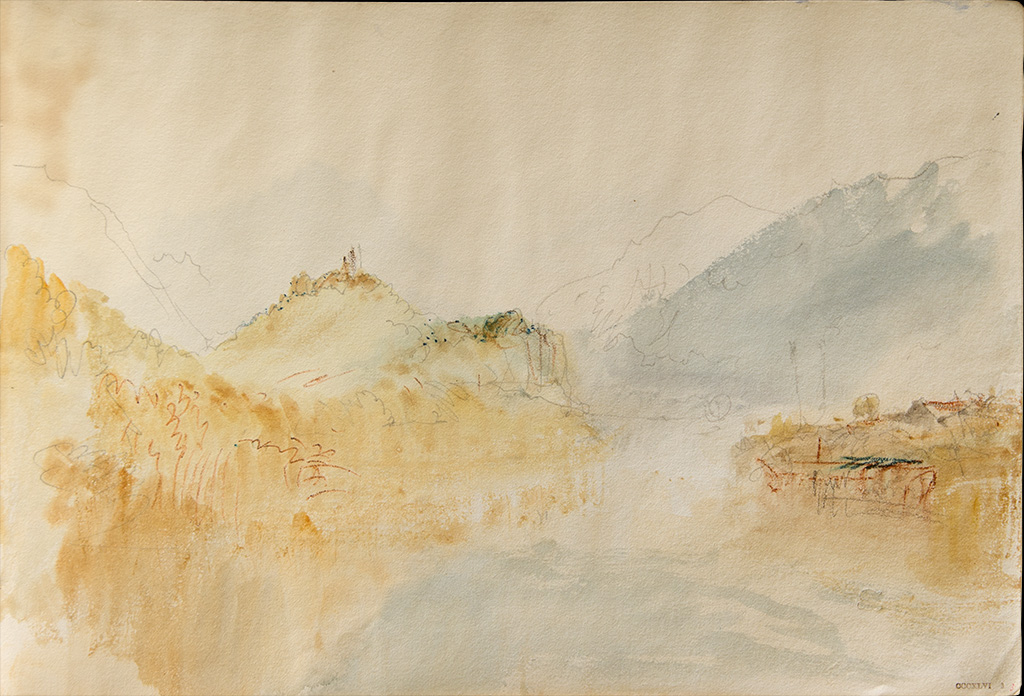
JMW Turner 1844 Our title: The Aare as it flows out of Lake Brienz, with the Faulhorn Mountain on the Right, and the Ruined Tower of Goldswil Church slightly left of center. Turner Bequest Thun, Interlaken, Lauterbrunnen and Grindelwald Sketchbook CCCXLVI Page 3 D35003 - Pencil, crayon and watercolour on paper 223 x 328 mm Public Domain Image by John Lumby ref 20150113-Q1379
In the late 1830s and up to this last tour of Switzerland, we see Turner making many of his sketches in watercolour. This is a notable point, as they mostly exhibit a revolutionary and previously unknown freedom of expression that differs markedly from his finished watercolours for clients. Importantly, these sketches are made in the main for himself. However, as one would expect of Turner the businessman, he also made semi-finished watercolour studies, called Preparatory Studies, to help encourage clients to commission finished work. Insufficient attention is paid to Turner's skill and success as a self-made businessman-artist.
To have a similar view today as Turner had above, we place ourselves on the modern elevated bridge:

Compare this with the above coloured sketch by Turner. © John Lumby ref: 20170408-7707
We now see clearly the River Aare re-formed as it exits the distant Lake Brienz. The foreground has been turned into a grassy meadow. To appreciate Turner's colours, take note of the natural tall grasses next to the river, and imagine them covering the entire foreground. Also, a little warm weather would turn the mound under the church tower much more yellow. But the most marked change is of course the housing.
However, the mountains are precisely the same.
Let's take a look at that tower and check-out the views from there :

Goldswil Tower of the former 11C St Peter's Church of Ringgenberg, Goldswil, Niederried, Unterseen and Habkern: a beautifully restored site offering magnificant views. (The tower itself is closed to the public). Image © Lumby 20170319-5304
View looking North-East along Lake Brienz :

So that you may find Ringgenberg Castle from the opposite direction to the Taft watercolour, we have cropped this image to place the castle church tower in the centre, backed by the surface of Lake Brienz. (It is not the large rectangular building right of centre).
This is one of our favourite views: the Little Goldswil-Interlaken Castle Lake (Burgseewli), with Lake Brienz in the distance, and on the left the Brienzer Rothorn (2244m / 7362ft) that has been reachable by a narrow-track rack steamtrain since 1892.
Here's the view from the tower, in the oposite direction :

The River Aare as it Flows Past Interlaken with the Abbey on the left with white, early 19th Century Hotel Interlaken nearby, the modern elevated road bridge, railway bridge, funicular slope - Image©Lumby20170408-7583
Here is the River Aare as it passed through today's Interlaken. Extreme left is the white former 12th century Augustinian Monastery & Castle Church, and to the right of it: the Catholic Church. On the right of our image is the steeply-sloping line of the Haderbahn funicular train. Turner's location for the above 1844 watercolour was from a bridge, not far from today's elevated roadway, from where we took our comprative photo.
We see the Lake Brienz tourist boats moored on the river, and are probably surprised to see that their passage towards the distant Lake Thun is blocked by a very low railway bridge. It is said the the railaway was deliberately routed to cross the river twice at very low level to prevent the by then particularly successful steamers from being able to operate on both lakes, passing between them along this stretch of the River Aare, thereby giving the railway company a competitive advantage.
The Hotel Jnterlaken, re-built in its present white architectural form in the early 19th century is just this side of the Catholic Church. It was one of the first modern high class hotels and is still here today; a centre of hospitality since 1491. Both Lord Byron and Felix Mendelssohn stayed here, and given that Turner in 1844 was staying at all the best hotels, it seems highly likely that he too would have chosen to stay here, and for a couple of nights.
In those days, this expanding village around the monastery was called Aarmühle (Aare Mill), with eventually a post office called Interlaken; this name being officially adoped for the entire 'Victorian' city, only in 1891.
Alternatively, he could have stayed a little further downstream in the main town of the day: Unterseen, where he made several sketches.
 Switzerland - ©Lumby20170404-6312+3.jpg)
Unterseen (near Interlaken) Switzerland - © John Lumby ref: 20170404-6312+3
As we see, Unterseen retains its former character and is particularly picturesque, with the riverside buildings little changed from Turner's day. From here, Turner would have taken a carriage to reach the little port of Neuhaus to catch the Lake Thun steamer and head for Berne.
It's now time to turn to a new page to take a look at a little of the surroundings of The Taft's Lake of Thun Turner painting, so we'll end this page here and be back soon to make a start on the Thun painting.
In the meantime, please visit aur sister website Art and Publishing where we welcome donations to help us keep up our investigative work to provide you with revised and extended information about Turner's works centred on and around Switzerland.
This page was updated on December 19th, 2025
115.png)