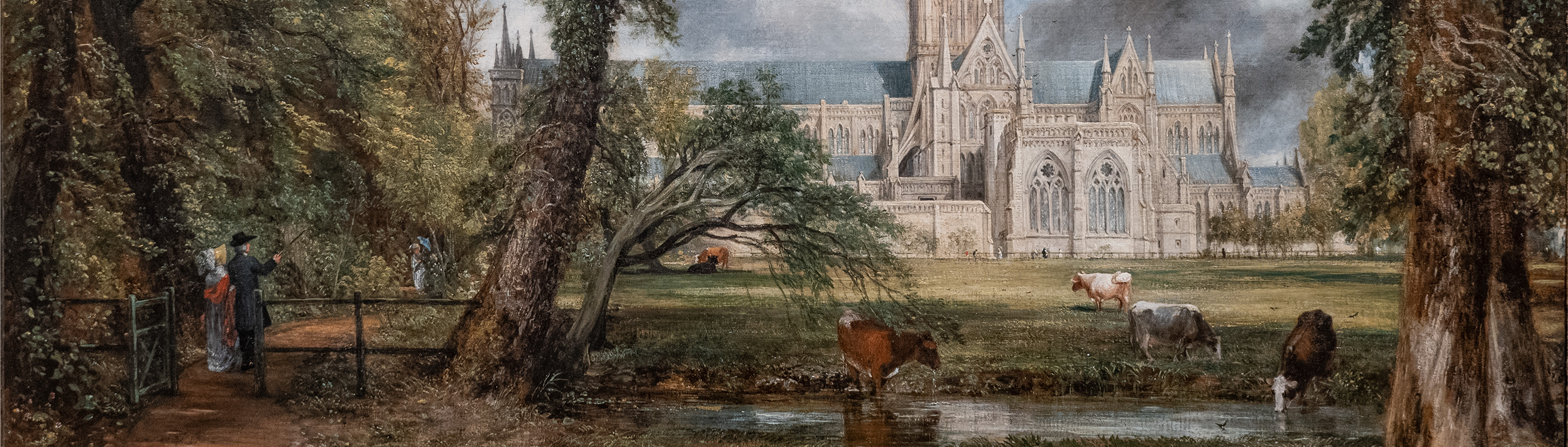
Salisbury Cathedral from the Bishop's Grounds by John Constable. Exhibited 1823. Courtesy The Victoria and Albert Museum London donated by J Sheepshanks
Salisbury Cathedral from the Bishop's Grounds by John Constable. Exhibited 1823. Courtesy The Victoria and Albert Museum London donated by J Sheepshanks
Prue Bishop - A personal reflection on this acclaimed exhibition
First Published in the British Art Journal on 28 February 2026
The title of this exhibition suggests that visitors are expected to decide who ‘wins’, and indeed the early online and printed press (including in France, Italy, and Spain) immediately adopted a competitive stance. Three years ago, I was told that Tate Britain had decided on a single exhibition to mark both artists’ 250th birthdays: JMW Turner (1775–1851), John Constable (1776–1837). I remarked then that some marketeer must have thought a ‘two-for-one’ approach was needed, whereas I believed they could easily have mounted two separate and highly successful exhibitions, one for each artist, a year apart. Both painters are unquestionably icons of 19th-century British art, and this exhibition includes many beautiful and inventive works, including notable loans. Yet the appreciation of these masterpieces is overshadowed by the needless competitive framing. The question who is winning obstructs deeper understanding.
The competition was unfair to both artists from the start, as key works – and entire themes – were absent. Even more oddly, few visitors seemed aware that a second, free, Turner and Constable display was available simultaneously in the Clore Gallery where the works of both artists are on view. Visitors in the paid exhibition were audibly confused. A man from Suffolk was upset that ‘the Tate has set this up for Turner to get Constable, even though we all know he was the more talented painter’. A woman complained that her favourite Turners – the Fighting Téméraire and Salisbury Cathedral – were ‘left out to let Constable win’.
Constable
Constable’s portraits were almost entirely absent, except for a single self-portrait on loan from the National Portrait Gallery. This deprives visitors of the chance to see the emotional and artistic breadth of his work. For example, the tender July 1816 portrait of Maria Bicknell (Pl 1), painted when they were finally free to marry, would have enriched the narrative enormously. Also missing were Constable’s delicate drawing of the young Maria (Tate T03900), his tiny oil of Maria with two children (Tate N03903), and his 1806 pencil self-portrait (Pl 2).
_-_Maria_Bicknell,_Mrs_John_Constable_-_Tate-N02655_-_wikimedia.org Public Domain.jpg)
1 Maria Bicknell by John Constable (1776–1837), 1816. Oil on canvas, 30.5 x 25.1 cm. Tate Britain
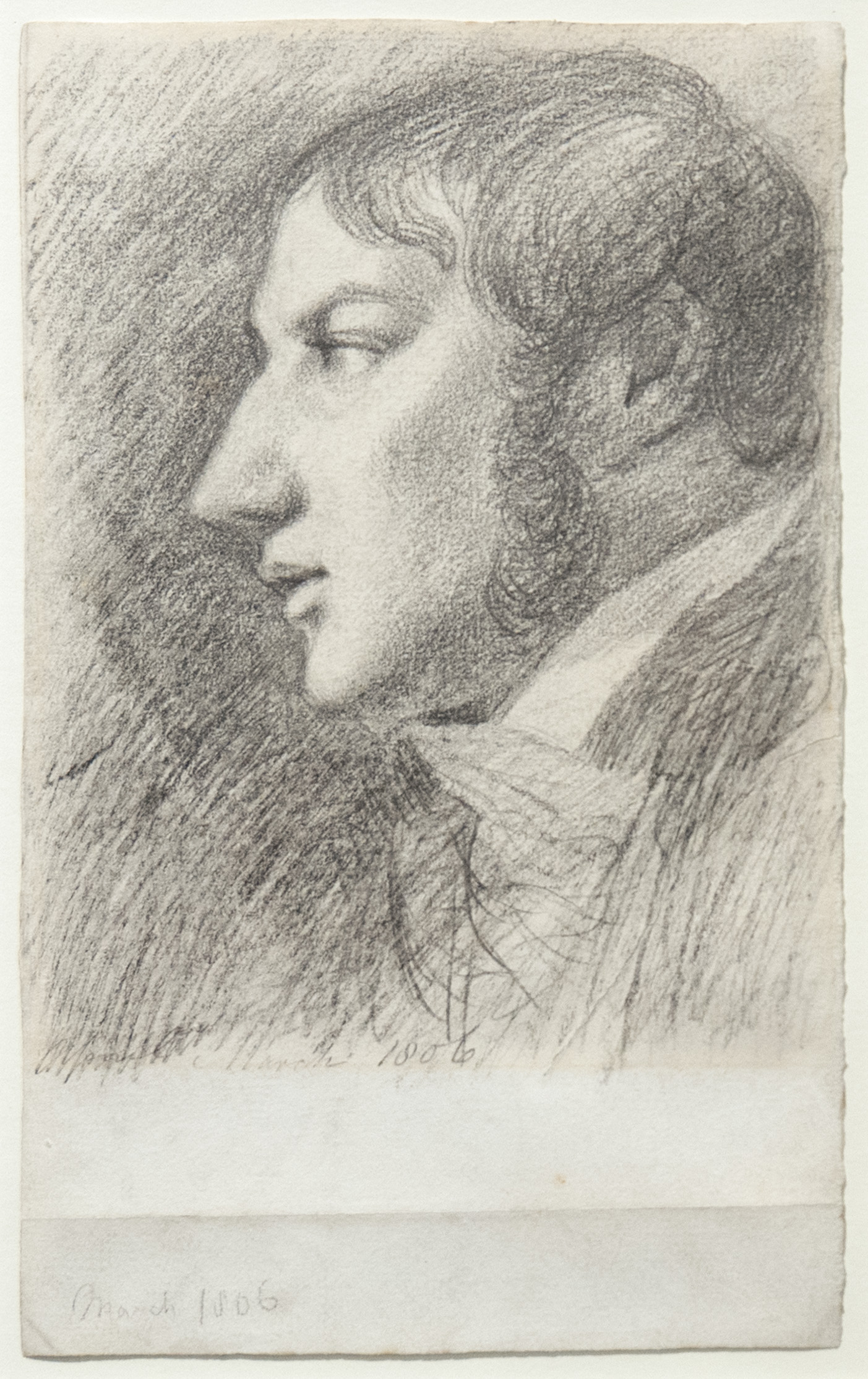
2 Self-portrait by John Constable, 1806. Pencil, 19 x 14.5 cm. Tate Britain
It is astonishing that Tate Britain should have kept these important works locked away. Their inclusion would have demonstrated that Constable’s gifts extended well beyond the pastoral scenes for which he is celebrated.
The exhibition also missed an opportunity to explain why Constable put such emphasis on Salisbury. It was Sir George Beaumont who recommended that, having been introduced, he developed a close relationship with the Bishop Dr John Fisher, as he was close to the Royal Family. The possibility of royal patronage was of central importance to Constable, and he was fortunate that the Bishop was himself a keen artist who introduced him to his young nephew, Archdeacon John Fisher, also an artist. The Archdeacon lived in Leaden Hall in the Cathedral Close at Salisbury and became Constable’s close confidant, and extending his friendship with the broader Fisher family.
We were not shown how Constable’s sketches deepened his engagement with the Cathedral and its surroundings, but we did see the magnificent result of a most important commission from the Bishop (Pl 3).
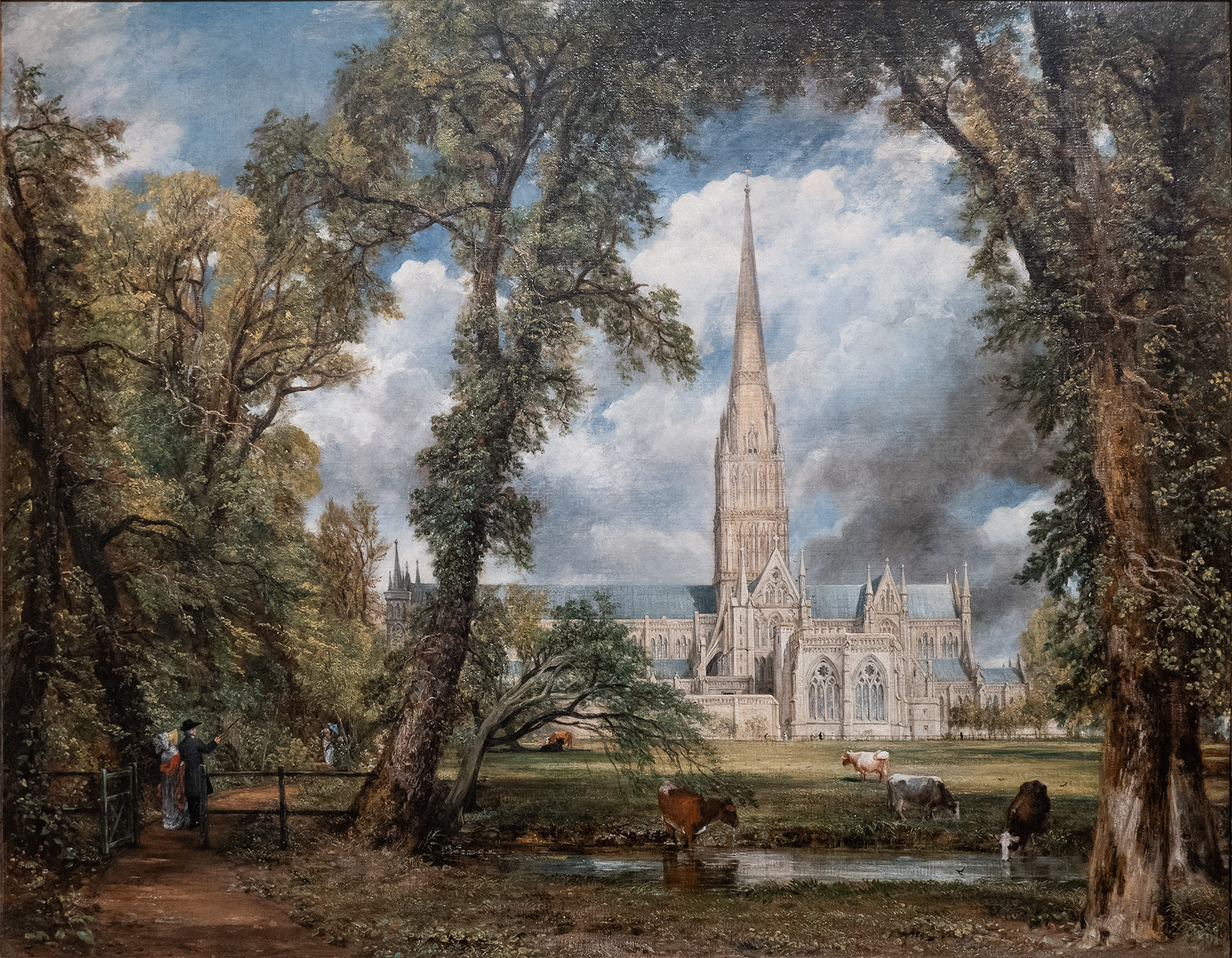
3 Salisbury Cathedral from the Bishop’s Grounds by John Constable, exhibited RA 1823. Oil on canvas, unframed 87.6 x 111.8 cm. Victoria & Albert Museum
Although the exhibition label accompanying the rather different Salisbury Cathedral from the Meadows (exhibited in 1831) notes the Bishop’s preference ‘for a more serene sky’, at the time it was known more generally that the Bishop did not like Constable’s rather dark skies. The broader narrative – Constable’s two more (same-sized) reworkings of this ‘most difficult subject’ – remained unexplored. Perhaps one day we might be privileged to study in London all three of these pictures at first hand: the second is a full-scale study at The Metropolitan Museum of Art New York (50.145.8), and the third is in the Frick Collection, also in New York. The dark cloud does not appear in the last version, and an in-depth analysis of all three, along with the various preparatory works would be especially rewarding.
The exhibition omits Constable’s sustained engagement with printmaking. His 1831 Salisbury Cathedral from the Meadows, which is on view (Pl 4), was central to a sequence of progressive improvements in the making of prints from his works that Constable oversaw while the lithographer John Lucas was working on them (Pl 4), yet none of this detailed material is shown. Without visual reference to Constable’s innovative approach to print, we are missing his keen desire to extend the success of his Salisbury work to broader critical acclaim.
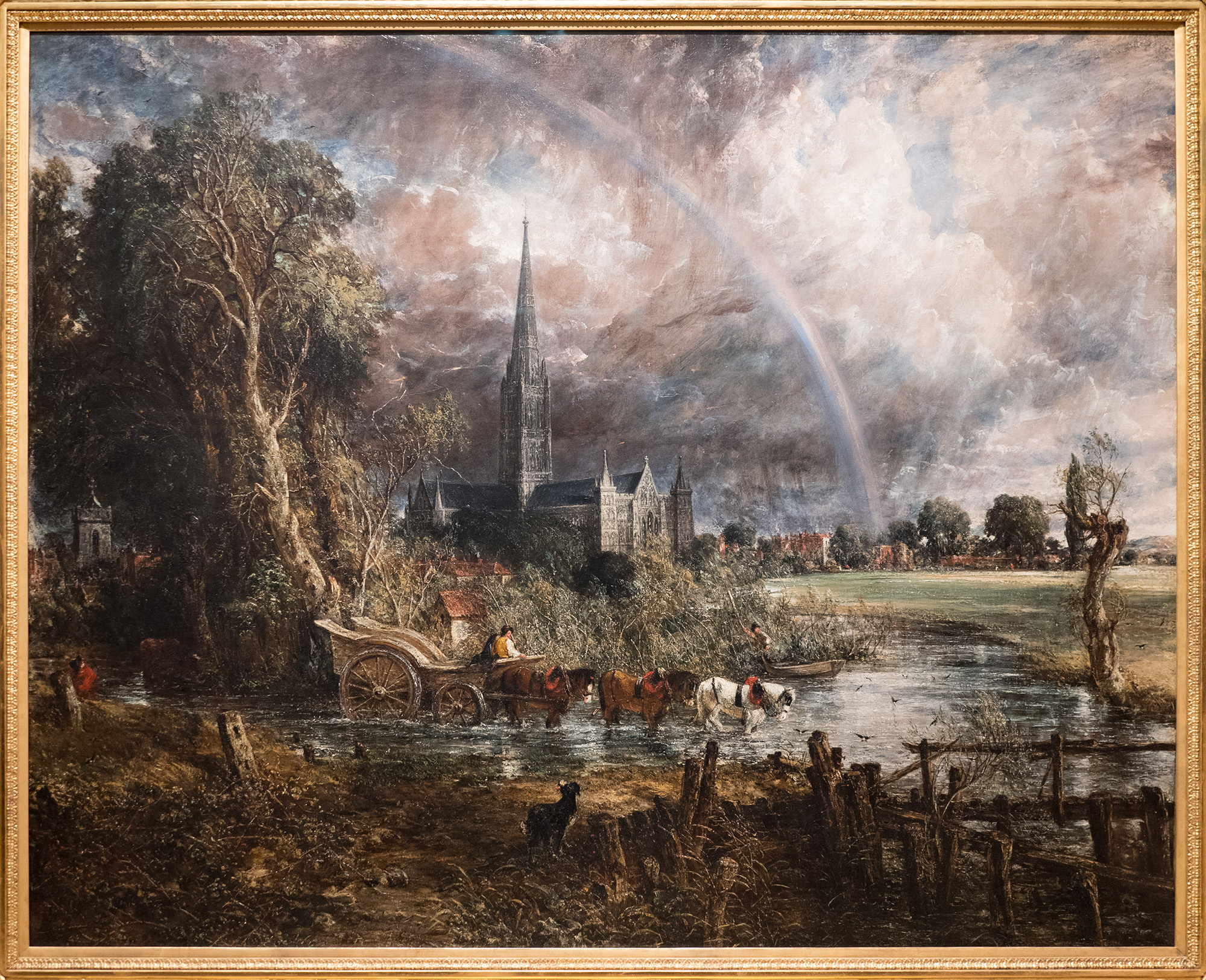
4 Salisbury Cathedral from the Meadows by John Constable, exhibited 1831. Oil on canvas, 153.7 x 192 cm. Tate Britain
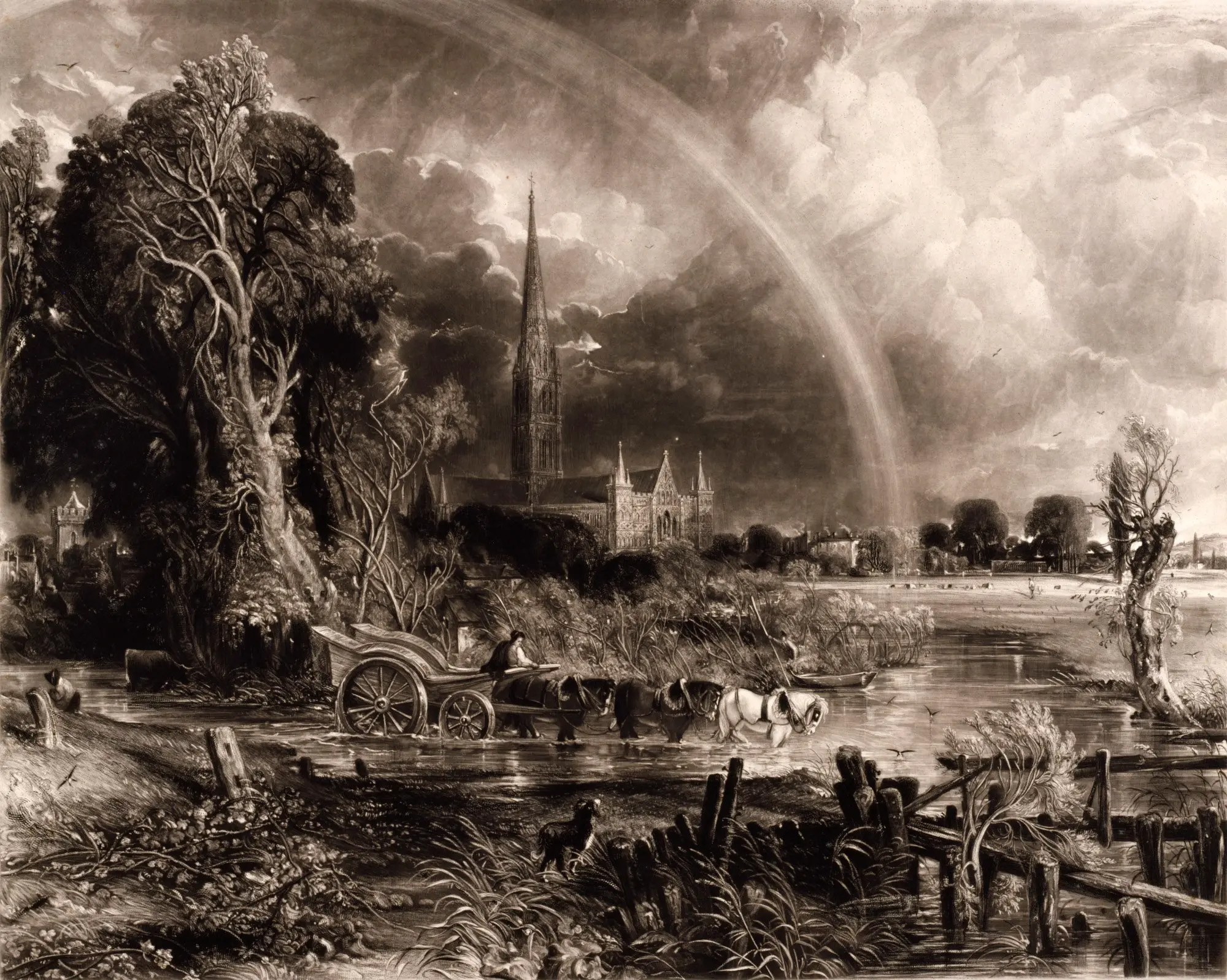
5 Salisbury Cathedral from the Meadows - Mezzotint 550 x 688mm by David Lucas after John Constable published Hodgson and Graves 20 March 1837 public domain image
Turner
Although Turner’s career is represented by major oils and a handful of watercolours, the exhibition provides only a partial view of his extraordinary geographic and artistic reach. Turner was a peripatetic figure whose Continental travels – from France, Belgium, the Netherlands and Germany to Switzerland, Austria, Denmark, Monaco, Italy, Liechtenstein, the Czech lands, and Poland (Szczecin) – yielded thousands of detailed drawings and watercolours alongside finished works. These journeys shaped nearly a third of his artistic output. This vast body of material is scarcely acknowledged. Visitors are given a narrow selection, with minimal context regarding the scope of Turner’s sketchbooks, itineraries, or his systematic investigations of European topography and architecture. The effect is a diminished understanding of Turner’s intellectual ambition and the structural role of travel in his artistic method.
The imbalance extends to Turner’s achievements as the leading book illustrator of his day. None of the watercolours created for the vignettes in Rogers’s Italy or Poems is included, despite their centrality to his reputation and their importance as a commercial and artistic endeavour (Pl 6). These vignettes circulated in thousands of copies, helping to establish Turner as Britain’s most sought-after illustrator and supporting his emergence as a financially independent figure with property, investments, and the means to stay in Europe’s finest hotels during his later tours.
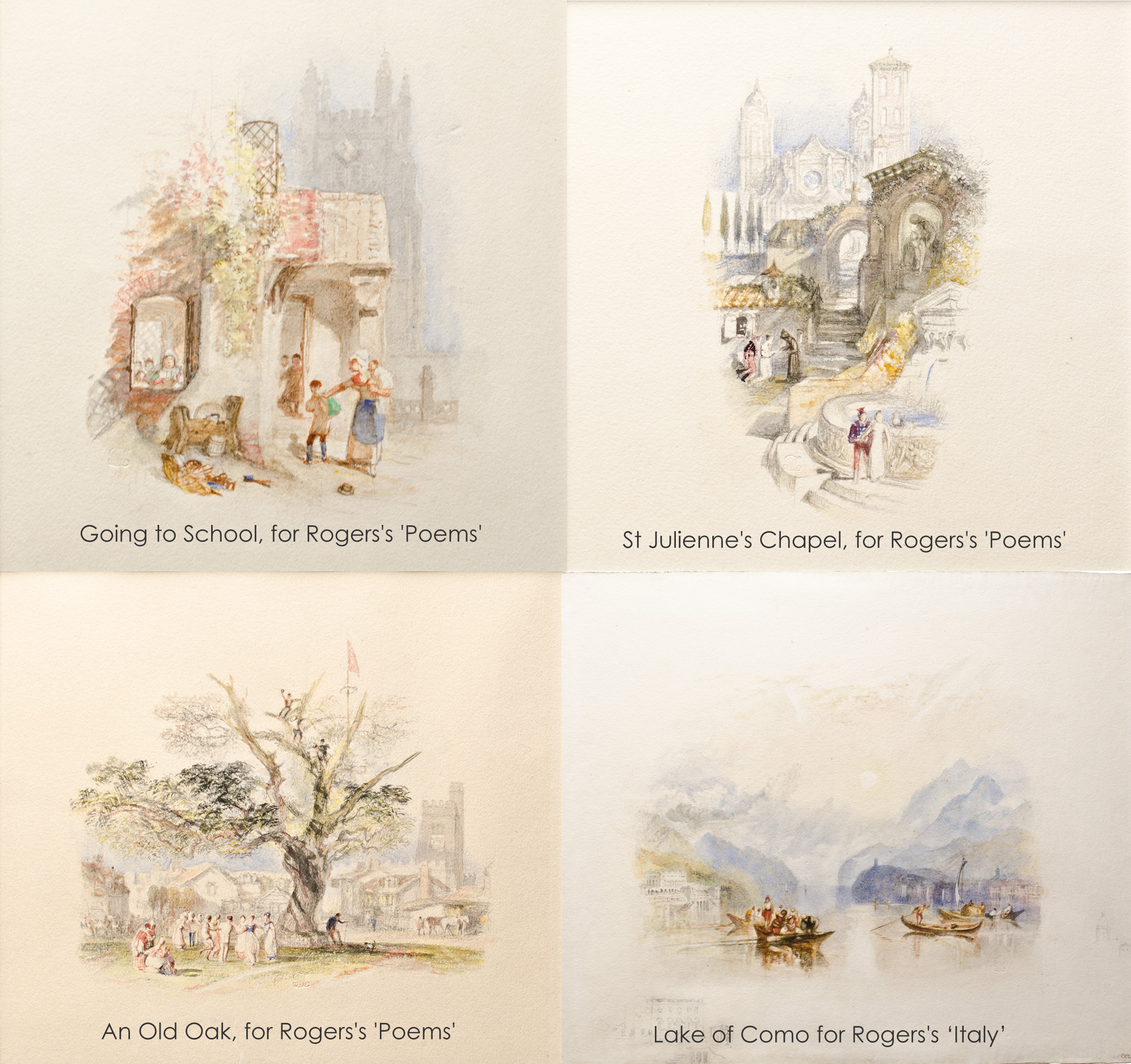
6 Vignette watercolours, Tate D27715, D27703, D27691, D27667, by JMW Turner (1775–1851) for Rogers’s Poems and Italy. Photography: John Lumby Bishop
If a joint exhibition was considered essential for marking the 250th birthdays of both artists, it could have focused productively on their complementary contributions to elevating landscape painting to a new level of public and critical significance. Instead of a competition, the emphasis might have been placed on: • Their differing responses to nature and topography • Their contrasting attitudes toward travel • Their divergent uses of colour, atmosphere, and narrative • Their parallel struggles for institutional recognition.
Such a framing would have enabled a richer understanding of their shared epoch and divergent accomplishments. Tate Britain’s ‘Turner and Constable: Rivals and Originals’ offers viewers an opportunity to see masterpieces by two of Britain’s greatest painters. Yet the curatorial choice to impose a competitive narrative, coupled with the omission of essential bodies of work, restricts a full appreciation of their achievements. Both artists merited individual exhibitions of comparable scale, each marking his 250th anniversary with all major aspects of his oeuvre represented. Only then could the public have formed a balanced understanding of their motivations, methods, and legacies.
As my plane carried me home via Geneva, I recalled Turner’s many Swiss subjects and his views across Europe. Yet I also felt a touch of homesickness for Constable’s Salisbury, where our son was born and christened in George Herbert’s little church, and where our daughter attended Leaden Hall School: John Fisher’s home in the Close, at the end of the rainbow. Salisbury also launched my own artistic career, teaching Art & Design at Bishop Wordsworth’s School and South Wilts Grammar.
Rogers published without images, resulting in very little interest. Turner suggested that were his illustrations to be added, Rogers's books would be a success - that proved to be correct.
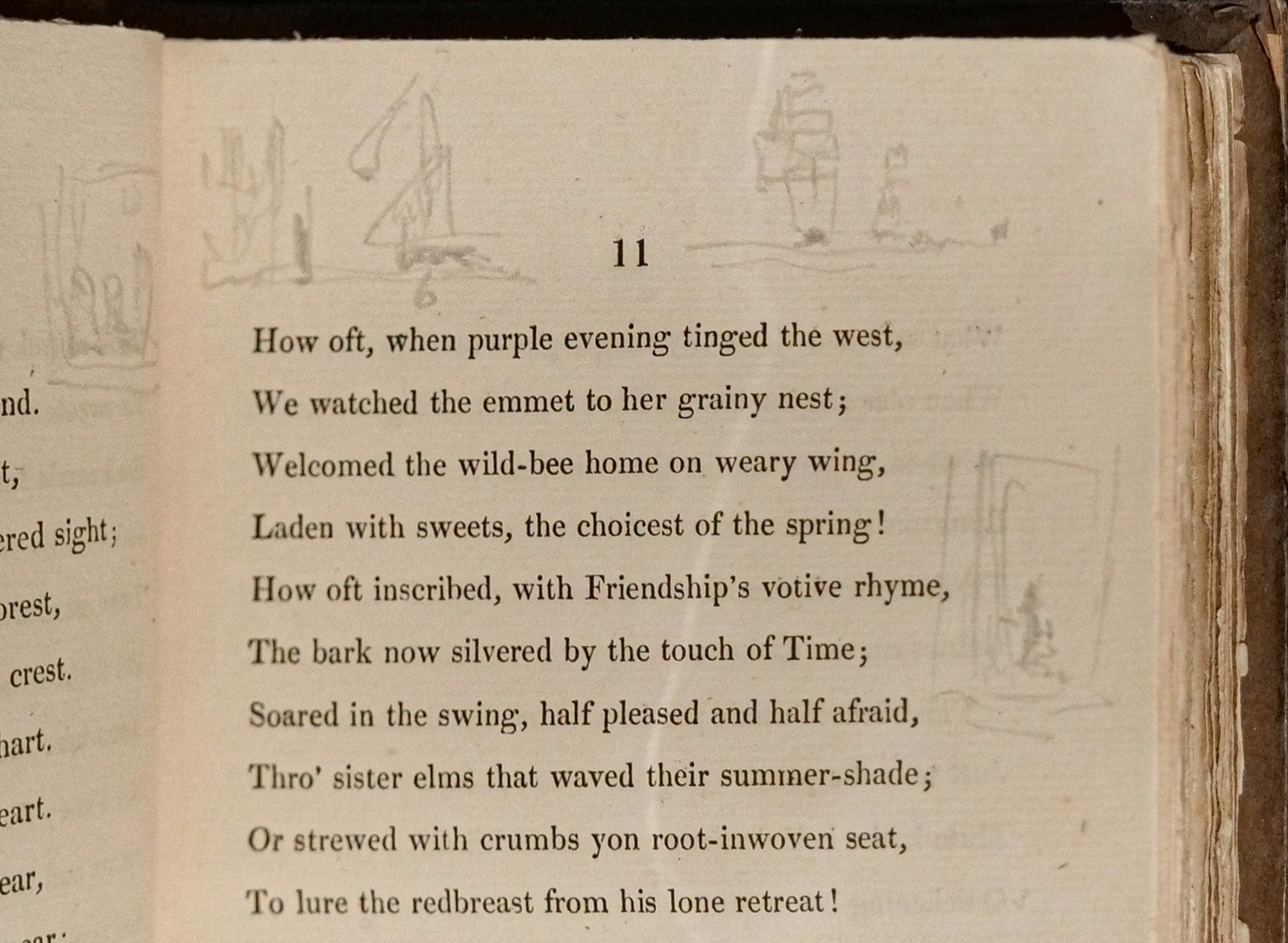
Turner's copy of Rogers's Poems - Page 11 of the un-illustrated and unsuccessful version - with Turner developing ideas in tiny pencil sketches in the margins - This copy is part of the Turner Bequest held by Tate Britain. This image is Public Domain
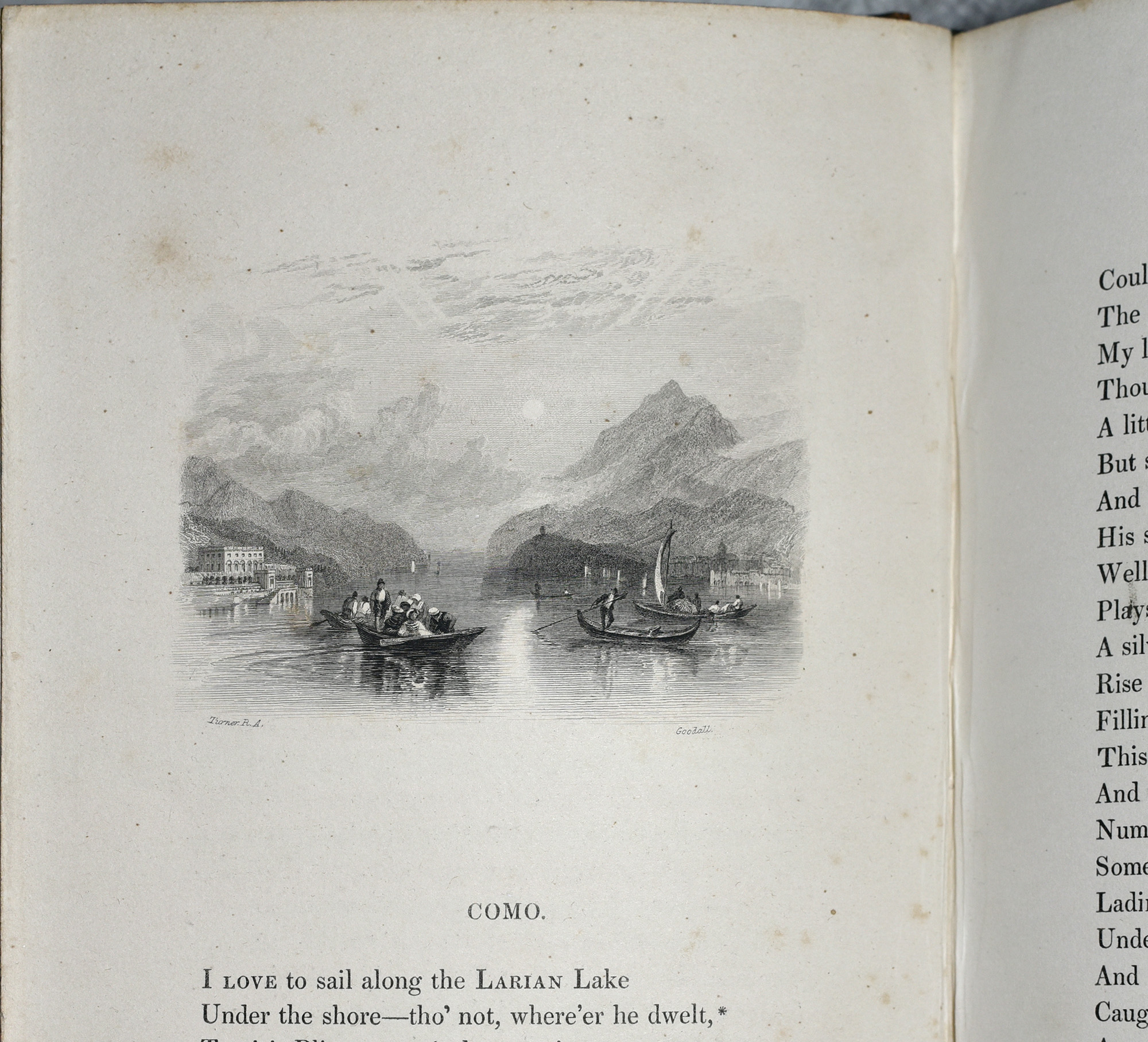
Roger's Italy page 32 - Vignette 'Como' by Goodall after Turner - Public Domain Image
The above vignette is typical of how the final versions appeared in both Rogers's Italy and Rogers's Poems books.
Should you wish to comment on the above article direct to the authors, or request additional relevant images to be displayed, please send an email to john.bishop@lumby.ch . We have already added the above section so that the form of the final vignettes is clear.
Please include a link to the relevant page and, where possible, a citation or image reference.
This page was published on March 1st, 2026
115.png)